
Colorado still attracts newcomers with mountain views, strong job markets, outdoor recreation, skiing, hiking, craft breweries, and more than enough sunshine to make the lifestyle feel special. But the cost of living in Colorado in 2026 is no longer easy to summarize with a single number.
Statewide, Colorado is more expensive than the U.S. average, but the gap changes sharply by city. RentCafe’s 2026 cost-of-living data shows Colorado is 4% above the national average, with housing 15% higher and utilities 10% lower than the U.S. average. Groceries are about 2% higher than the national average.
That makes Colorado a middle-to-high-cost state, not as expensive as California or New York, but more expensive than Texas, Oklahoma, Alabama, and much of the Southeast. For many households, the key question is not simply whether Colorado is affordable. It is whether Denver, Boulder, Colorado Springs, Fort Collins, Pueblo, or Grand Junction fits the budget.
Housing is the highest cost in Colorado

Housing is the main reason Colorado feels expensive. Zillow listed the average Colorado home value at $543,270 as of May 31, 2026, down 2.3% over the past year but still far above many U.S. markets.
Buying a home in Colorado can be especially difficult for families moving from lower-cost states. A down payment, closing costs, mortgage interest, property taxes, homeowners’ insurance, maintenance, and utilities all add to the true cost. Even if prices have cooled in some areas, monthly payments can remain high because mortgage rates remain a major factor in affordability.
Renting can be a better short-term choice for many newcomers. It gives people time to test a city before buying and usually requires less money up front. RentCafe reported the average Colorado apartment rent at $1,824 in June 2026, down 2.44% from the prior year. Studio apartments averaged $1,381, one-bedroom units averaged $1,618, and two-bedroom apartments averaged $1,990.
Denver and Boulder remain the expensive choices

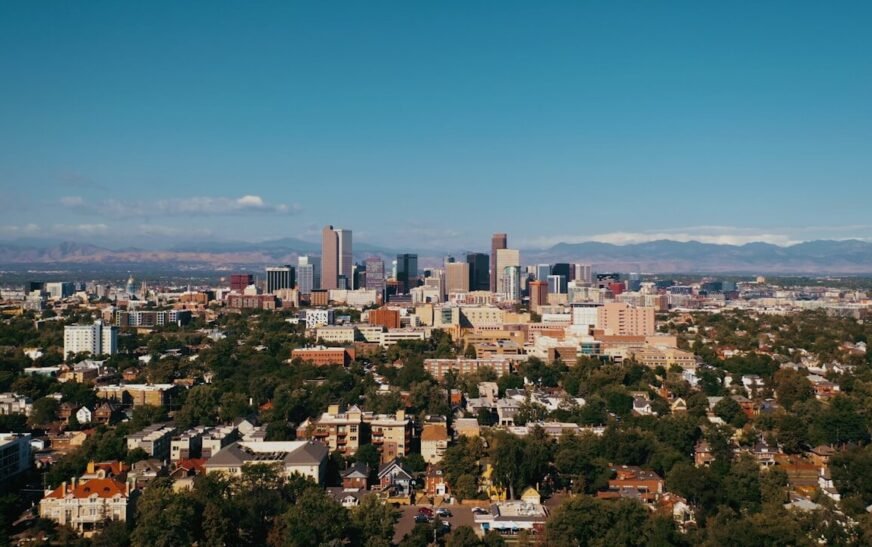
Denver is Colorado’s economic center, and its prices reflect that. RentCafe says Denver’s cost of living is 5% above the Colorado average and 9% above the national average. Housing in Denver is 22% more expensive than the U.S. average, while utilities are cheaper than average.
For workers in tech, health care, energy, aerospace, finance, and professional services, Denver may still make sense because salaries can be higher than in smaller Colorado markets. But renters and buyers need to plan carefully. A household that spends too much on Denver housing may have less room for savings, child care, vehicle costs, or mountain travel.
Boulder is even more expensive. Zillow listed Boulder County’s average home value at $727,957 as of May 31, 2026, with a median sale price of $724,800 in April 2026. Boulder’s high prices are tied to the University of Colorado, tech jobs, strict land-use limits, outdoor access, and strong demand from high-income buyers.
Colorado Springs and Fort Collins offer different trade-offs
Colorado Springs is often the value option among Colorado’s major Front Range cities. It has military employers, including Fort Carson and the U.S. Air Force Academy, as well as a growing economy and lower housing costs than in Denver or Boulder. Families who want mountain access without Denver prices often look here first.
Fort Collins is pricier but highly desirable. Zillow listed the average Fort Collins home value at $568,335 as of May 31, 2026, down 1.2% over the past year. The city benefits from Colorado State University, bike-friendly neighborhoods, breweries, strong schools, and access to northern Colorado recreation.
These cities show why Colorado’s cost of living is so local. Colorado Springs may work for a middle-income family that cannot afford to live in Boulder. Fort Collins may suit people who want a college-town lifestyle and can afford higher housing costs. Denver may work for those with stronger salaries or career goals tied to the metro.
Pueblo and Grand Junction are more affordable alternatives
For people who want Colorado without the highest Front Range prices, Pueblo and Grand Junction deserve attention. Pueblo often ranks among the cheaper major cities in Colorado. RentCafe’s 2026 data says Pueblo’s cost of living is 12% below the Colorado average and 7% below the national average.
Grand Junction is more complicated. It can be cheaper than Denver or Boulder in some categories, but RentCafe says Grand Junction’s cost of living is 7% higher than the national average, with housing 21% above the U.S. average. The appeal is lifestyle. Residents get access to the Western Slope, mountain biking, wine country, desert landscapes, and outdoor recreation without living in the Denver-Boulder corridor.
Retirees, remote workers, and families with flexible jobs may find the best Colorado value outside the state’s most famous cities. Lower housing costs can matter more than being close to downtown Denver.
Taxes help offset some Colorado costs
Colorado has a simple income tax structure. The Tax Foundation lists Colorado’s individual income tax rate at a flat 4.40% for 2026. The state also has a 2.90% state sales tax rate, though local sales taxes can raise the total depending on city and county.
Colorado’s biggest tax advantage is the property tax. Tax Foundation data shows Colorado’s effective property tax rate is about 0.49%, one of the lowest rates in the country. AARP’s 2026 Colorado tax guide similarly notes a flat 4.4% income tax and property taxes around 0.5% of a home’s assessed value.
That matters because high home prices do not always mean extreme property tax bills. A $500,000 home in Colorado may carry a lower annual property tax bill than a cheaper home in a high-tax state like Texas, New Jersey, or Illinois.
Utilities, groceries, health care, and transportation

Utilities are one area where Colorado can be more budget-friendly. RentCafe says utilities are 10% lower than the national average statewide. The dry climate can reduce air conditioning costs compared with humid states, although winter heating still matters, especially in mountain areas.
Groceries are slightly higher than average, but not dramatically so. The bigger difference is dining out. Denver, Boulder, Aspen, Vail, and other high-demand areas can make restaurants and entertainment feel expensive.
Health care is another major factor. Salary.com ranks Colorado No. 26 among states for overall health care access and affordability, meaning costs and access are not the worst in the country, but they still deserve careful planning. Employer coverage, deductibles, specialist access, and rural location can all change the true cost.
Transportation depends on lifestyle. Denver has the state’s best transit network, but much of Colorado is car-dependent. Gas, insurance, maintenance, registration, snow tires, and mountain driving can add to the budget. Winter driving may also require better tires or all-wheel drive for people who travel through the mountains.
Is Colorado worth the higher cost of living?
Colorado can be worth the cost for people who take advantage of what the state offers. Outdoor enthusiasts, tech workers, health care professionals, aerospace workers, military families, remote workers, and active retirees may find that the quality of life justifies the premium.
The state is less ideal for people whose top goal is the lowest possible cost. If mountain access, climate, recreation, and Colorado’s job markets are not major priorities, cheaper states may stretch income further.
The smartest move is to compare city by city. Denver and Boulder require higher incomes. Colorado Springs and Fort Collins sit in the middle. Pueblo can be one of the better affordability plays. Grand Junction offers outdoor value, but housing should still be checked carefully. In Colorado, the right city can make the difference between feeling stretched and feeling settled.
TLDR
- Colorado’s cost of living in 2026 is about 4% higher than the U.S. average, according to RentCafe.
- Housing is the biggest driver, with the average Colorado home value around $543,270 as of May 2026.
- The average apartment rent in Colorado was $1,824 in June 2026.
- Denver and Boulder are the most expensive major options, while Pueblo is one of the most affordable.
- Colorado Springs is often a better value than Denver or Boulder in the Front Range.
- Colorado has a flat 4.40% income tax and low effective property taxes of around 0.49%.
- Utilities are about 10% lower than the national average, which helps offset some housing pressure.
- Colorado is worth it for outdoor access and strong job markets, but affordability varies widely by city.